I Came Off the Shot and Gained It All Back. Then I Found Out What Switched My Hunger Off in the First Place. It Wasn’t Food.


If You Eat Less Than Everyone Around You and Still Can’t Lose It, Read This First
Let me guess.
You’ve tried everything. The 1,200-calorie plans. The fasting windows. The 5 a.m. treadmill.
Maybe even the shot.
You’re more disciplined than anyone you know. You count, you measure, you say no.
And your body holds on to every pound like it’s preparing for a disaster.
Then someone, a doctor, a friend, your own reflection, says the two most exhausting words there are: “try harder.”
So let me say the thing nobody said to me for fifteen years.
It was never your willpower.
Your body wasn’t broken. It was doing exactly what it was designed to do. It was just doing it all day, every day, because a switch inside it got stuck in the ON position.
I’m going to show you what that switch is, why everything you tried may have been pressing it harder, and the simple morning ritual that finally worked for me.
Read this before you spend another dollar on anything else.
I Lost 38 Pounds on the Shot. Ten Weeks After I Stopped, I Had Gained Back 44.
My name is Laura. I’m 52. Two grown kids, a job I’ve had for nineteen years, and a diet history longer than my résumé.
Two years ago I did what millions of women did. I got on the weight-loss injection.
And I’m not going to lie to you: it worked. For the first time in my adult life, the constant chatter about food went quiet. I lost 38 pounds. People noticed. I bought jeans in a size I hadn’t seen since my thirties.
Then my insurance stopped covering it. Paying out of pocket was over $1,000 a month. I stopped.
Ten weeks later I had gained back 44 pounds. More than I lost.
I got thin in front of everyone. And then I got big again in front of everyone. Nobody said a word, and the silence was worse than if they had.
I was sure it proved something about me. It worked for everyone. It even worked for me. And I still ended up here.
My doctor’s advice? Eat less, move more. My cortisol and thyroid tests? “Normal.”
So I went back to what I knew. 1,200 calories. Fasting until noon. Treadmill at 5 a.m., on an empty stomach, with black coffee.
And I gained seven more pounds.
At 1 A.M. I Asked the One Question That Changed Everything

One night I couldn’t sleep. (I never could anymore. I’d wake up at 3 a.m. with my heart going and my mind racing.)
I was reading about why people regain after the injections, and I found the explanation nobody had given me before my first dose.
The shot doesn’t restart your fullness signal. It supplies one from the outside.
So the day you stop, there’s nothing underneath. That’s not a personal failure. That’s how it’s designed.
Which left me with the only question that ever really mattered:
The answer surprised me, because I’d been living with it every day of my life and never once connected it to my weight.
The Most Overworked Country on Earth Has an Obesity Rate Around 4%. That Should Be Impossible.
Here’s the fact that cracked it open for me.
Japan has one of the most brutal work cultures on the planet. Twelve-hour days are normal. The pressure is so extreme they have a word for dying from overwork: karoshi.
By every rule we’ve been taught, they should be among the heaviest people alive.
Instead, Japan’s adult obesity rate is around 4%. In America, with a gym on every corner, it’s over 40%.
If this were only about calories and exercise, those numbers would be flipped. They aren’t.
And one of the most obvious differences happens in the first ten minutes of the morning.
We reach for coffee. For generations, Japan has reached for matcha.
To see why that matters, you need to understand what was really happening inside my body.
It’s Not That You Eat Too Much. Your Body Thinks It’s in an Emergency That Never Ends.
Picture yourself walking to your car at night. Someone steps out of the shadows.
Before your brain even registers it, your body has already reacted. Heart pounding. Palms sweating. Legs ready to run.
That’s cortisol, your main stress hormone. An ancient survival system, and in that parking lot, it’s your best friend.
But your body fires that same system for the inbox. The traffic. The bills. The guilt about lunch. The phone in bed at midnight.
None of them are predators. Your body doesn’t know that.
In a healthy body, cortisol peaks in the morning to wake you up, then drifts down all day until it’s low at bedtime.
But under constant modern stress, each spike starts before the last one ends. The line never comes back down.
Your body reads that as a permanent emergency. And a body in an emergency does two things extremely well:
It holds on to fat. And it screams for food.
The Two Signals That Go Quiet (and Why the Hunger Never Stops)
You’ve heard of GLP-1. It’s the hormone the injections are built around. What most people don’t know is that your gut makes its own, right after you eat, along with a partner hormone called GIP.
GLP-1 tells your brain: “You’ve eaten. You’re safe. You can stop.”
GIP helps tell your body: “Use this as fuel.”
Research increasingly links chronically high cortisol with disrupted appetite and fullness signaling. When those signals go quiet, two things happen at the same time, no matter how carefully you eat:
The hunger never fully shuts off. And more of what you eat gets stored.
And then the loop closes.
- Constant stress keeps cortisol high
- Your body shifts into “survival mode”
- Fullness and fuel-burning signals go quiet
- Food noise all day, fat stored around the middle
- Inflamed belly fat feeds more stress signaling, and the loop tightens
That hard, round belly that showed up even though your arms and legs stayed the same? That’s visceral fat, packed deep around the organs. It’s inflammatory, and inflammation keeps the alarm running.
That’s why it gets harder every year instead of easier. The loop feeds itself.
And my “normal” cortisol test? A blood draw measures one moment, usually in the morning, when cortisol is supposed to be high. It can’t tell you if it ever came back down. It measured one minute of my day and ignored the other 1,439.
There Are Only Four Ways to Fix This. Three of Them May Be Making It Worse.
Once I understood the real cause, the question got simple: how do you get your body out of emergency mode?
There are only four ways people try. Let me save you years.
Way #1: Dieting.
In one study, researchers put 121 women on a 1,200-calorie diet and measured their stress hormones. Restricting calories significantly raised cortisol.
Your body can’t tell the difference between a diet and a famine. Both read as an emergency. Aggressive fasting can do the same.
Way #2: Hard cardio.
Long, intense workouts can push cortisol well above baseline. Fasted, at 5 a.m., on top of a calorie deficit, on top of yesterday’s guilt?
I was stacking the alarm every single morning. The harder I pushed, the tighter the lock got.
Way #3: The shot.
Yes, it can work while you’re on it. But it supplies the signal from outside. It doesn’t touch why your own signal went quiet.
And studies following people after they stop show most of the weight tends to come back within a year or two. That’s not a cure. It’s a rental. At over $1,000 a month.
Way #4: Calm the alarm, cool the loop, then let the signals come back. In that order.
This is the one nobody talks about, because it isn’t a drug and you can’t patent a leaf.
Interrupt the Alarm. Cool the Loop. Restart the Signals. In That Order.
This is the part most “cortisol” tips get wrong. One ingredient can only do one job. If you skip a step, the loop just keeps feeding itself.
Step One. Interrupt the alarm. (Ceremonial matcha.)
Matcha is rich in EGCG, a green-tea compound studied for its role in the body’s stress-hormone pathway. It’s why the Japanese morning looks so different from ours.
Coffee on an empty stomach can push cortisol higher in a body that’s already running hot. Matcha helps the day start by calming the alarm instead of feeding it.
Step Two. Cool the loop. (Turmeric.)
Remember the inflamed belly fat that keeps sending the alarm back into your system? Curcumin is one of the most studied natural compounds for supporting a healthy inflammatory response.
This is the step that matters most for the stubborn cases. Without it, matcha is bailing water from a boat with a hole in it.
Step Three. Restart the signals. (Cinnamon, ginger and probiotics.)
Cinnamon supports healthy blood-sugar levels, which helps with the afternoon crash and the 3 p.m. pantry trip.
Ginger supports AMPK, the cell’s “burn it, don’t store it” switch.
And a targeted probiotic blend supports your gut, the place where your body makes its own GLP-1 and GIP.
Interrupt. Cool. Restart. Not one trendy ingredient. Five, working in order.
“Can’t I Just Buy Matcha at the Grocery Store?”
That’s exactly what I did first. It didn’t work.
Here’s what I learned the hard way.
Most grocery-store matcha is culinary grade. Late-harvest leaves, made for lattes and baking. The quality varies enormously, and most of it tastes bitter enough that I quit after a week anyway.
Plain turmeric is poorly absorbed. Most of it passes right through you unless it’s in a form made for absorption.
And matcha alone is only Step One. If inflamed belly fat keeps sending the alarm back, calming it in the morning isn’t enough. I felt a little something for a few days, then nothing.
What finally worked was the complete ritual: all five, in the right forms, already measured, in one capsule. No whisking, no bitter taste, nothing to measure, and nothing to make me quit in week two.
What Happened When I Tried the Complete Morning Ritual
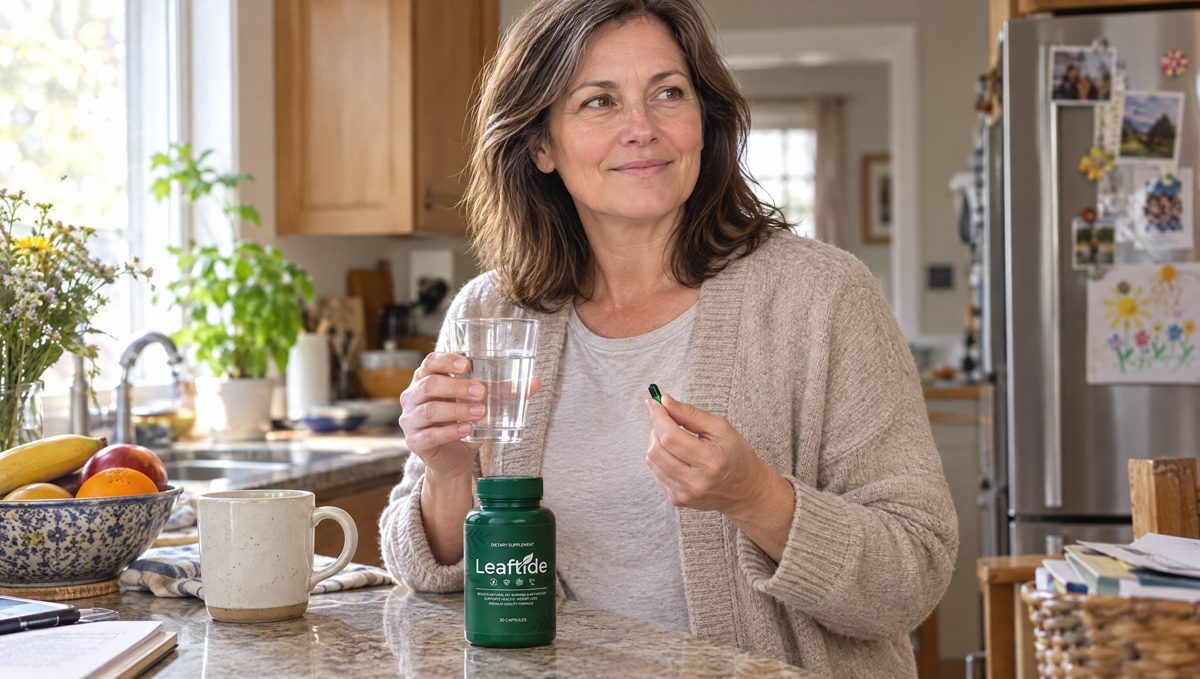
One capsule, one glass of water, every morning. That’s it. No diet. No 5 a.m. treadmill.
Week one, I noticed it at 3 p.m., standing in the kitchen. I didn’t want anything. The noise was just… quieter.
Week two, I woke up before my alarm and didn’t feel like I’d been hit by a truck.
Week five, my jeans buttoned standing up.
And this time, when the noise went quiet, I understood why. I wasn’t counting the days until it stopped working. Nothing was being supplied from the outside. There was nothing to take away.
Laura’s experience is her own. Individual results vary and are not typical.
The Ritual Is Called LeafTide

- First-harvest ceremonial matcha from Uji, Japan: shade-grown, hand-picked, stone-ground
- Micronized turmeric, cinnamon, ginger and a targeted probiotic blend
- One capsule a day, no taste, nothing to mix
- Made in the USA in an FDA-registered, GMP-certified facility
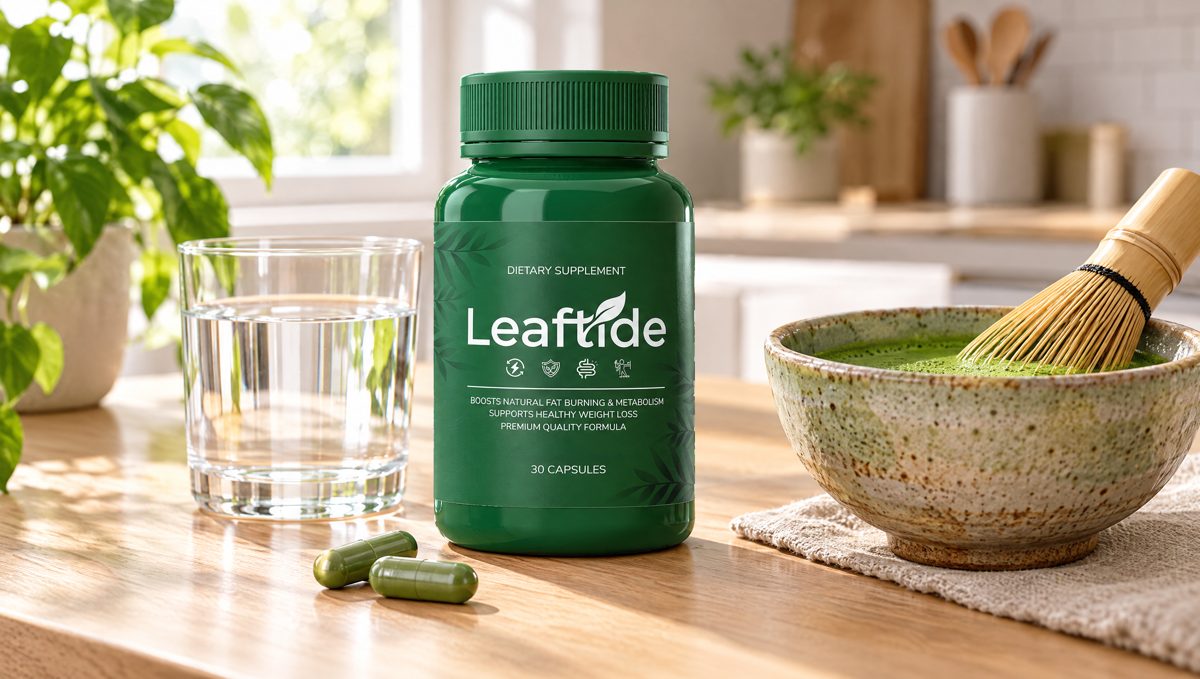
Uji, near Kyoto, is where Japan’s finest tea has been grown for centuries. LeafTide uses first-harvest leaves only, picked by hand once a year and stone-ground, then pairs them with the four ingredients that make the other two steps possible.
Let me be clear about what it is not.
It’s not a drug. It’s not an injection. It doesn’t contain GLP-1, and it’s not a replacement for anything your doctor prescribed.
It’s not another single-ingredient “hack.”
It’s the complete morning ritual, built around the reason your body got stuck in the first place.
The Shot Rents You the Result. This Is Built to Let Your Body Keep It.
Let’s talk about what this has already cost you.
The injections that rent you weight loss: over $1,000 a month, for as long as you can afford them.
Everything you’ve already spent on programs, shakes, gummies and memberships: for most women, thousands of dollars.
LeafTide costs a small fraction of that. It’s only sold on its official website, not on Amazon or in stores, and right now the maker is running a buy-more-get-more-free offer with free shipping.
TODAY’S OFFER · FREE SHIPPING
Get Free Bottles With Your LeafTide Order
Check today’s availability and pricing on the official website.
90-day money-back guarantee on every package.
Most women choose the 6-bottle supply. Partly to save, and partly because the loop took years to build, and giving your body a full few months to reset is what makes it stick.
CHECK TODAY’S LEAFTIDE OFFER →Official Website · 90-Day Money-Back Guarantee
Try It for 90 Days. If It’s Not for You, You Get Your Money Back.
I know you’ve been burned before. So have I.
That’s why I’m glad the maker takes the risk off you. Every LeafTide order is covered by a 90-day money-back guarantee.
Take it every morning. Notice the noise. Notice your energy. Notice your clothes.
If you’re not satisfied for any reason, contact the company within 90 days for a full refund.
90-Day Money-Back Guarantee
If you’re not happy with LeafTide, contact the manufacturer within 90 days of purchase for a full refund. Your only real risk is another year stuck in the loop.
Here’s How to Start Tomorrow Morning
It’s simple.
- 1. Tap the button below and choose your supply.
- 2. Enter your details on the secure, official checkout page.
- 3. Your LeafTide ships straight to your door, free.
Tomorrow morning: one capsule, one glass of water. Before the coffee, if you still drink it. (I do. Just not first.)
Then get on with your day and let your body stand down from an emergency that was never real.
SEND ME MY LEAFTIDE →Six Months From Now, You’ll Either Be Out of the Loop, or Still Reading Articles Like This

Here’s the truth nobody likes to say. The loop doesn’t fix itself.
Every month it runs, the belly fat inflames, the inflammation keeps the alarm on, and the alarm stores more fat. One turn tighter.
The saddest words I hear from women are always the same: “I wish I’d started sooner.”
Picture it instead. The food noise, gone. Opening the fridge, looking, and closing it again. No negotiation. No guilt.
Waking up before the alarm. Being in the photo instead of always taking it.
Looking in the mirror and thinking “I look good.” Not good for my age. Not good for someone who’s had kids. Just good.
You spent years fixing the wrong thing, and the fix was making it worse. It was never you.
START MY LEAFTIDE MORNING RITUAL →Buy 3, Get 3 FREE · Free Shipping · 90-Day Guarantee